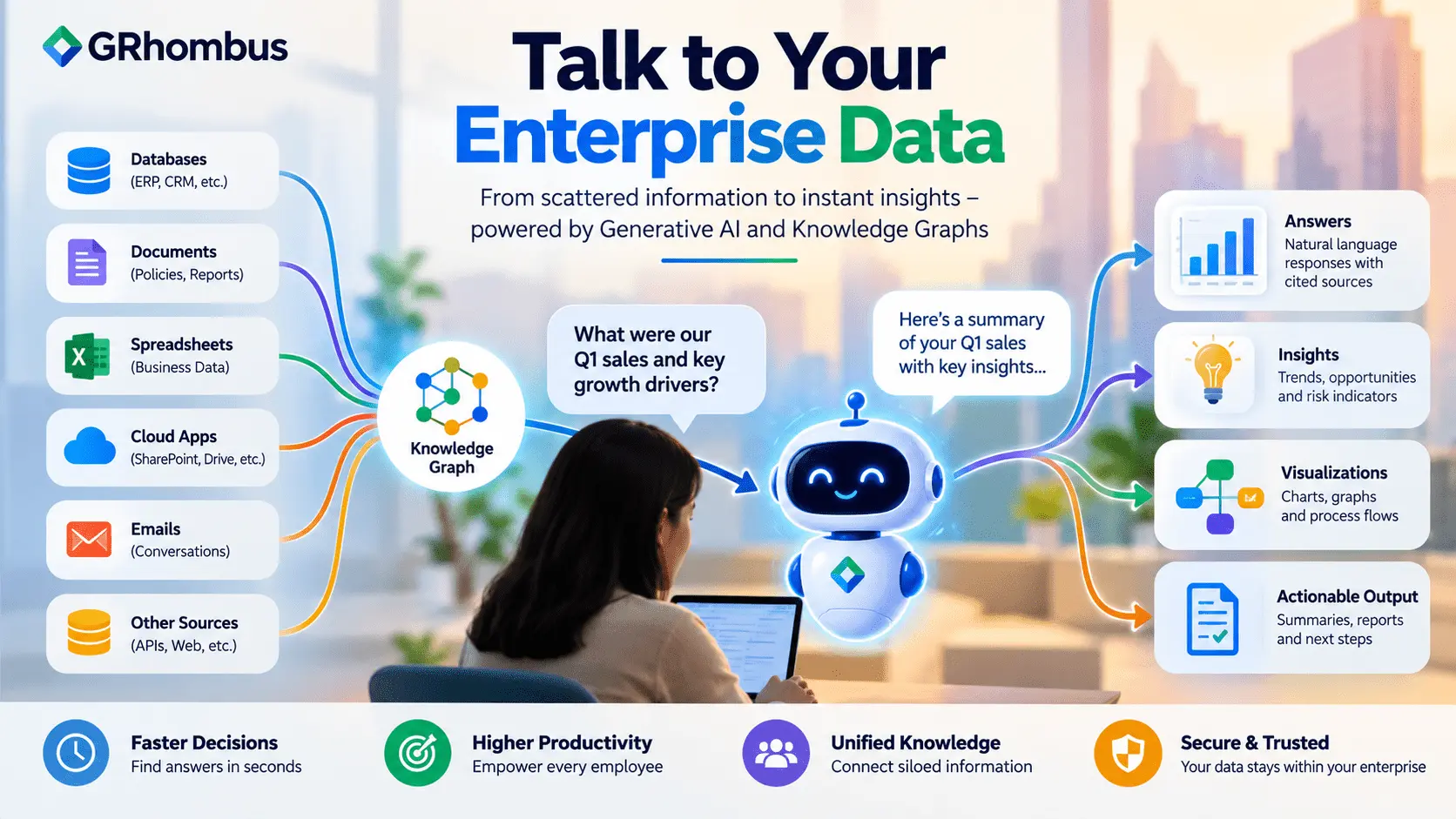
Talk to Your Enterprise Data
How AI can turn everyday business questions into trusted, data-backed answers — while keeping your database, security controls and governance at the center.
Most organizations are not short of data. The challenge is getting the right answer from that data quickly, safely and without depending on a technical specialist for every business question.
Your business already has the answers
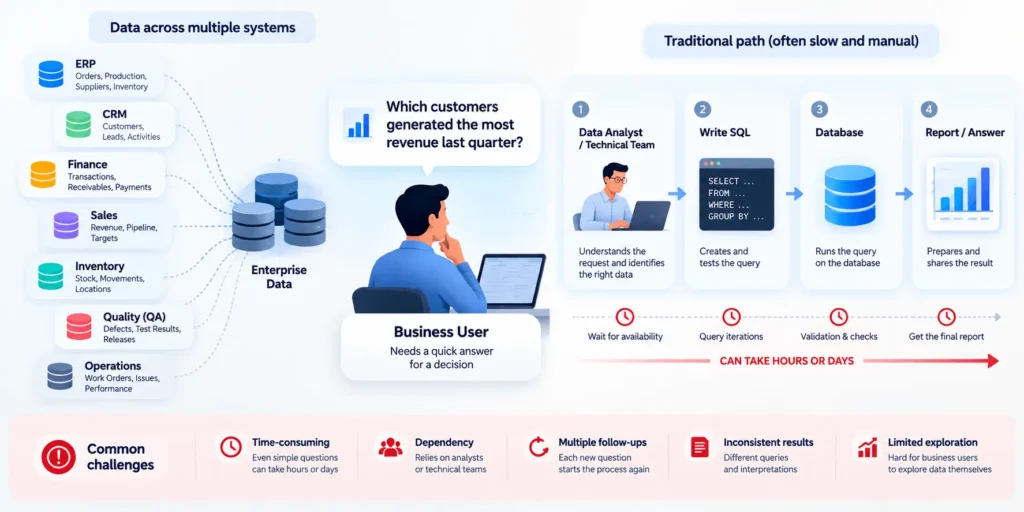
Sales data is in the ERP. Customer information is in the CRM. Transactions are in financial systems. Production, inventory, quality and operational metrics sit across databases and enterprise applications.
Yet a seemingly simple question can still start a chain of emails, tickets, SQL queries and reports.
Who were our top five customers last quarter?
Which locations had the highest number of operational issues this month?
Which application modules had the most failures in our latest release?
Which locations had the highest number of operational issues this month?
Which application modules had the most failures in our latest release?
The information may already exist in the database. But answering the question often requires someone who understands the schema, identifies the correct tables, writes SQL, validates the query and prepares the result.
Then comes the follow-up question: “Can you compare that with the previous quarter?”
And the process starts again.
What if business users could simply ask the data?
Instead of expecting every user to understand tables, joins, schemas and SQL syntax, a user asks a question using normal business language.
For example:
“Which customers generated the most revenue last quarter?”
AI can interpret that question and translate the intent into the appropriate database query.
KEY INSIGHT
AI should not be the source of your business answer. Your
database remains the source of truth.
The distinction matters. The AI helps determine what to ask. The database supplies the actual information.
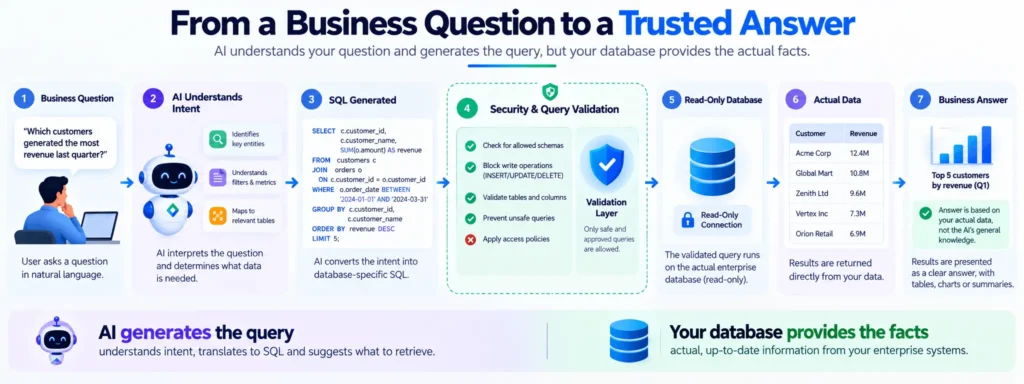
From a business question to a trusted answer
A practical implementation places controls between the AI and the underlying database rather than simply allowing generated SQL to execute without supervision.
Understand the available data
The system works with approved database schemas to understand which tables, columns and relationships are available. If the available data cannot answer a question, the application should clarify the request rather than manufacture an answer.
Generate the query
AI translates business intent into database language. In this role, the model acts as a translation layer rather than the source of business facts.
Validate before execution
Generated SQL should pass through controls before reaching the database. The application can restrict access to approved schemas, reject write operations and block queries that do not meet organizational policies.
Important distinction
AI can propose what to query. The platform determines what is allowed to run.
Execute against real business data
Once validated, the query can execute through a read-only database connection. The resulting answer is therefore based on actual organizational data rather than the language model’s general knowledge.
Why this matters to the business
The real opportunity is not simply being able to “chat with a database.” It is reducing the friction surrounding everyday access to operational information.
01
Faster answers
Routine questions can be answered without waiting for another report.
02
Less repetitive work
Analysts spend less time producing variations of similar SQL queries.
03
Broader data access
Business users can work with information without learning database syntax.
04
Greater transparency
Users can understand the query and data behind the resulting answer
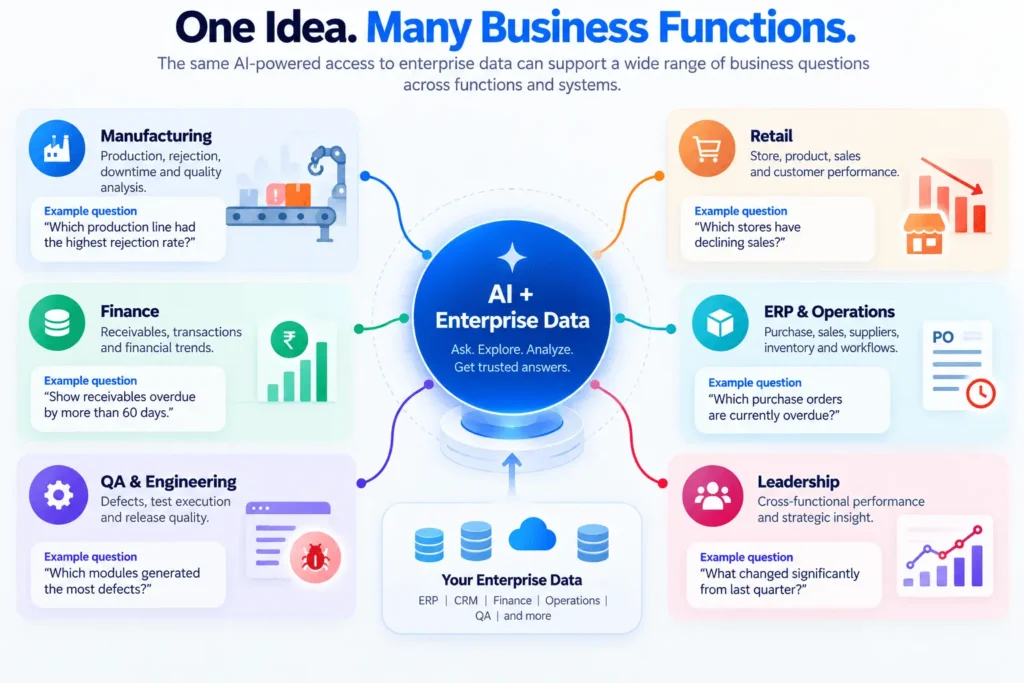
Where can this be useful?
The same model can support very different questions depending on the organization’s systems and available data.
⚙
Manufacturing
Production, rejection, downtime and quality.
“Which production line had the highest rejection rate?”
▦Retail
Store, product and sales performance.
“Which stores have declining sales?”
₹
Finance
Receivables and transactional analysis.
“Show receivables overdue by more than 60 days.”
↗
ERP & Operations
Purchase, inventory and supplier activity.
“Which purchase orders are overdue?”
✓
QA & Engineering
Test execution, defects and releases.
“Which modules generated the most defects?”
◎
Leadership
Cross-functional operational insight.
“What changed significantly this quarter?”
From one question to a conversation
Business analysis rarely ends with the first answer. Once context is established, users can naturally continue exploring the same information.
This makes the experience less like requesting individual reports and more like exploring organizational data directly.
What about security?
Connecting AI to enterprise data should never mean giving a model unrestricted access to business-critical systems.
A secure implementation needs boundaries at both the application and database level.
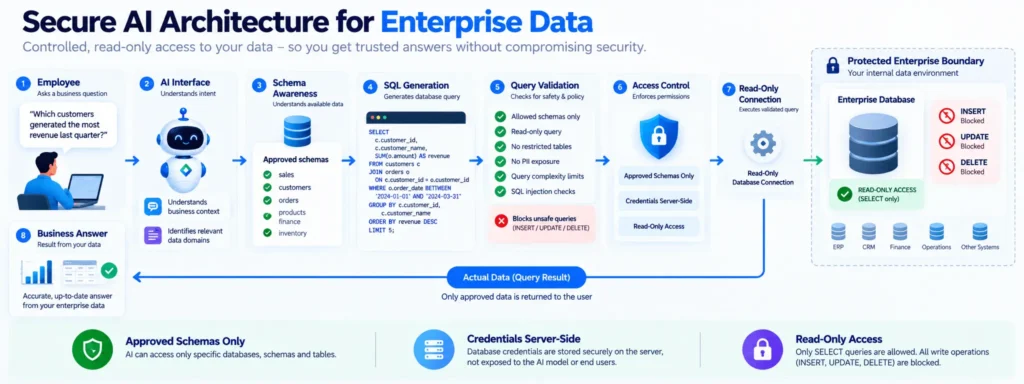
Read-only access
Database credentials used for exploratory AI interactions can be restricted to read operations, creating a fundamental permission boundary.
Query validation
Generated queries can be checked before execution so unsafe operations, unauthorized tables or unsupported structures can be rejected.
Approved schema access
AI visibility can be limited to approved databases, schemas, tables and columns rather than exposing everything within the organization’s environment.
AI doesn’t replace data governance
Natural-language database access is not a replacement for governed reporting, carefully defined business metrics, enterprise data warehouses or experienced data professionals.
Some questions require carefully modeled data. Others require complex analysis or standardized definitions. Important decisions still require human interpretation.
AI-powered database interaction is better viewed as another controlled access layer over enterprise information.
AI interprets the question.
Governance controls the access.
Your data provides the answer.
The opportunity is particularly strong for the thousands of everyday questions where the required information already exists and the biggest barrier is simply accessing it efficiently.
Bringing AI closer to enterprise data
Enterprise AI does not always require replacing existing systems. In many cases, the more practical opportunity is to make the systems and data organizations already have easier to use.
Combining AI, Data Engineering and enterprise application expertise can create a simpler path from a business question to a trusted, data-backed answer — while maintaining the controls surrounding that information.
The data may already exist. The next opportunity is making it easier for the right people to ask the right questions.
GRhombus Perspective
Explore AI-powered access to your enterprise data
GRhombus combines AI, Data Engineering and enterprise application expertise to help organizations explore practical approaches to making existing business data more accessible while maintaining security and governance.